she echoes
“What if we were to turn ends into multiple beginnings?”

This piece of writing is a further offshoot from arranging the pieces, an excerpt from a collaborative writing “exquisite corpse” started earlier this year with Emily Orley.
Emily has been an echo, an ear, and an opening (to borrow her words) for my substack muse, which often gets caught up in the hairball of the family home, searching for a way through the paraphernalia of life and loss. This season, the summer of dry grass and full moon swims, has brought with it a propulsion toward the completion of a chapter - as the family ghosts reshuffle, feelings surrounding the mother-daughter relationship surface with greater volume.
“And starts, of course, are often also ends. Or they begin in someone else’s middle. As children of mothers, as we are, as humans, we might remember that we arrived on the planet, inevitably, and necessarily, as interruptions in the cycles of another. We were born into cyclical time. Times of iteration. Beginnings, ends, continuations, echo, echo.”
“To choose to write about Echo, then, is already to echo a whole series of other voices, which carry their own reverberations”
Echo as an argument between mother and daughter. The daughter, an aspiring and ever-establishing artist, has returned from overseas where she lives and works, to be with her mother for a week in the family home by the seaside. Every time she returns, she tries to get rid of something that displeases her. Most of the objects in the home are worn out, stained or at the point where the plastic has changed colour and is sticky to the touch. Sometimes she replaces useful items with a new version from the shopping mall, which is a convenient walk away - through the woods at the back of the house. Other times she sneaks the offending item into the garage, where the mother never goes, and later gets a friend to help her take everything to the tip. Luckily, this town is small and the tip is also just a walk away, through the woods in the other direction. She often feels like she is in a fairy tale, walking through the woods, except there are no wolves, only abandoned office chairs and empty cans of beer. The woods split into three paths, the third takes her to Lidl, where she can buy groceries for the mother who rarely leaves the house.
“Echo as de-stabiliser”
Sometimes it is so stifling in the house that the daughter will rearrange the furniture of her bedroom, or start obsessively cleaning the fridge. Lately she has taken to assigning each room as an art project in its own right. The garage becomes a future workshop, the living room a place to have friends over. Actually, her salvation, as well as her biggest challenge, is to transform her fathers music studio into an art studio. This has taken many sporadic evenings, wading through many years of bank statements, photos, obsolete printers, records, pairs of glasses, hi-fis, CD’s, DVDS, cables of every size, instructions for every appliance ever bought.. and finally it feels like it could be empty enough to work on multiple projects at the same time and not have to restart them every time. Echo, as a process.
She echoes her father in his obsessive note making and his habit of humming as he worked. He wrote and composed music to understand the world, although he never made anything that he would admit to be ‘serious’, although it definitely was to him. She echoes her mother in her emotional outbursts, a fiery temper that when provoked, is best left alone to work itself out inside its own echoes.
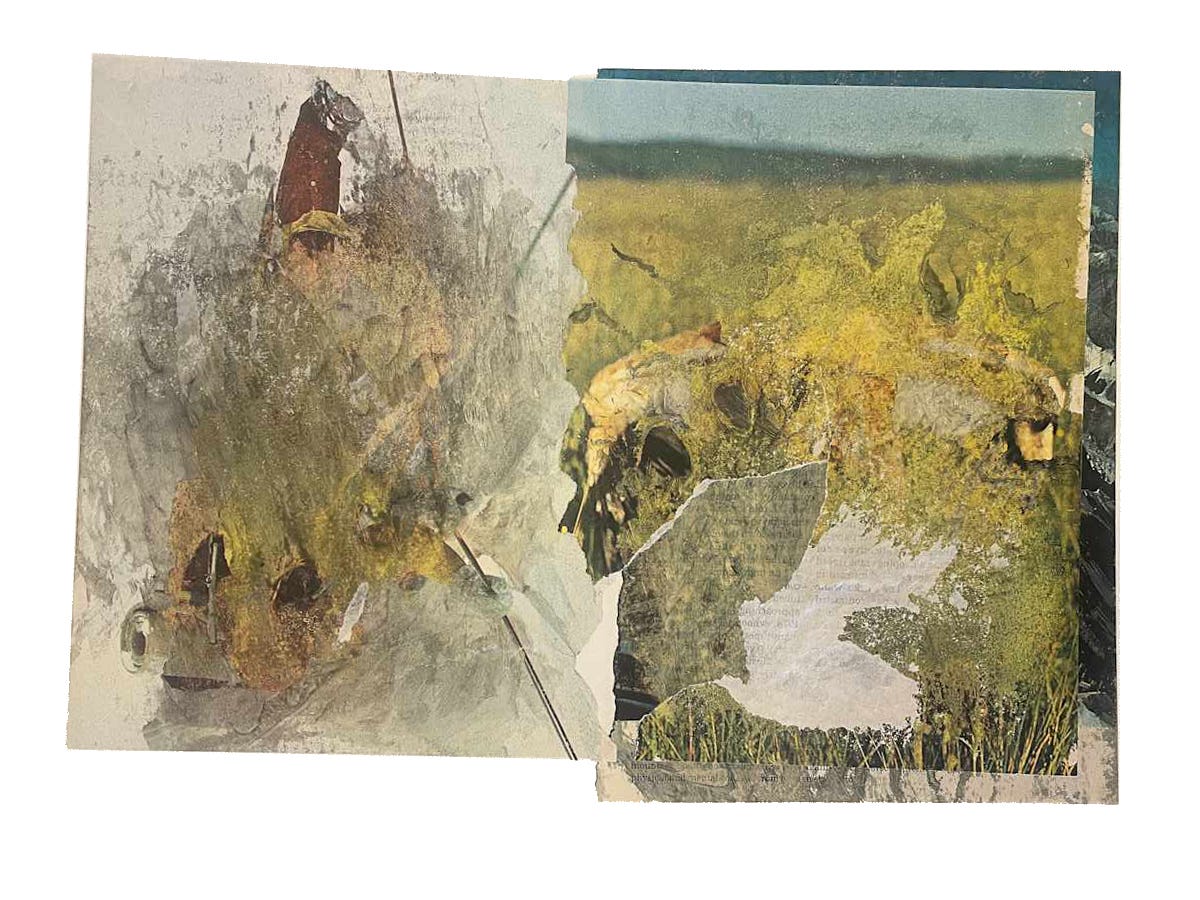
Her artistic process involves acknowledging echoes - in her diaries and notes - that later resonate into projects, into ideas. The recycling process often takes the form of tearing up paper to make paper mache, or collage.
“what does it mean not to seek to dominate, to resolve or to escape?”
Living with the idea that ‘care’ is acceptance of the difficult, the illogic, the static, and the non-static process of ageing - something that cannot be dominated, resolved or escaped.
Incidently “Escape”, is the title of a collage the daughter made during 2020, perhaps before the pandemic, she doesn’t remember. It sat in the mind of a friend of hers and became a stubborn key, poking deep down into her past and driving her to write a novel about the experience of having never known her own mother. A beautiful and impossible story that speaks of a childhood searching for an echo - anything at all - that would bring her closer to being a daughter. She later purchased the work and they began a poetry book collaboration together in 2022.
Echo as collaborator.
One person’s wish is the other’s command. Wait, is it? A distorted echo implies a change in frequency, shape or timing. If an echo is a call and response, then what if the call is misheard? Or the response was deliberately re-interpreted…
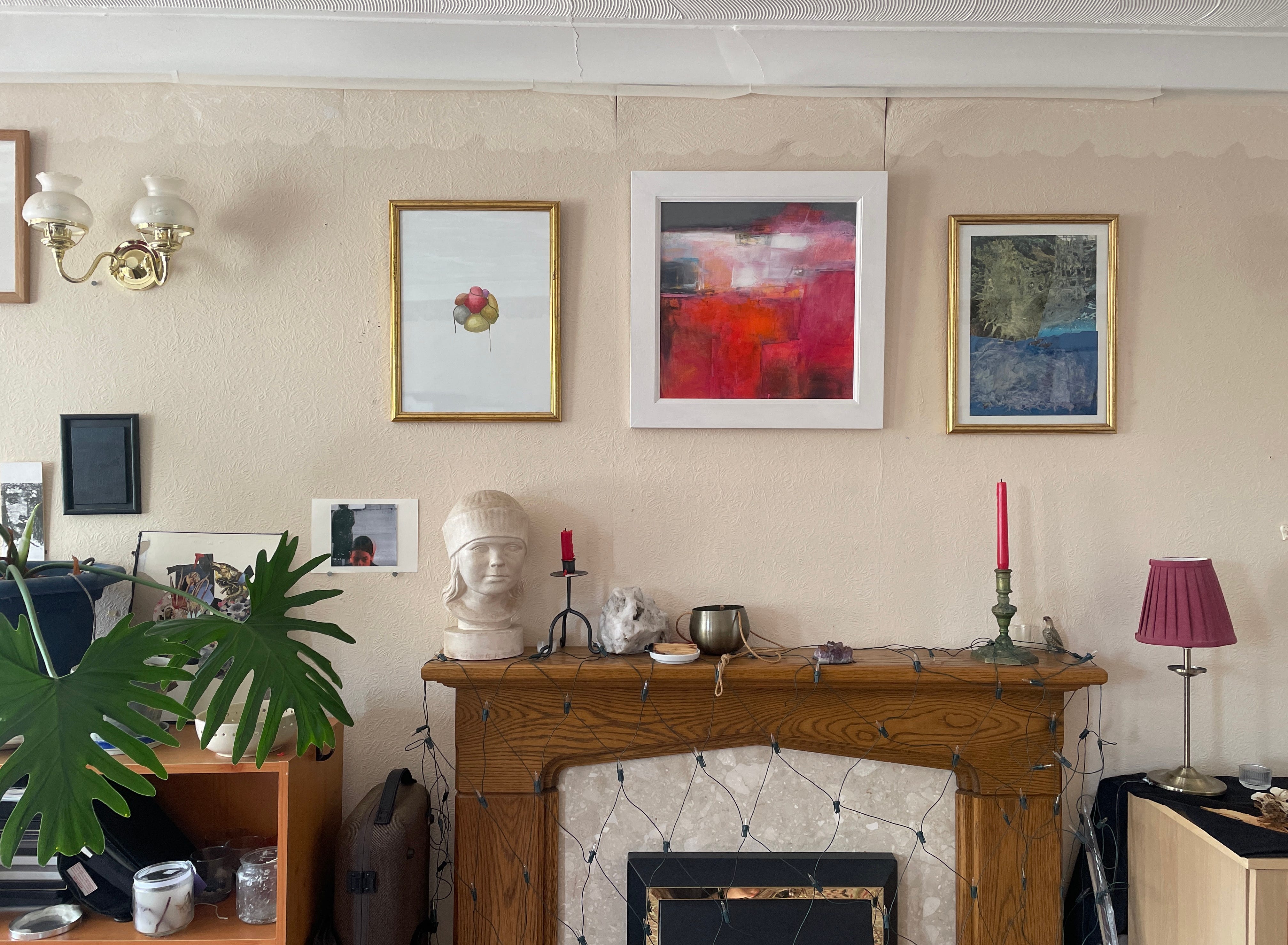
The daughter knows that reorganising the living room will disturb the mother, at least for the short term. She knows that there will be a drama of sorts, a cry for ‘reorder’, an attempt to control the situation. The daughter echoes the control (or reasserts it) through the movement of pictures on the wall, her own artwork, a lot of it she doesn’t agree with. She needs to change the frequency. Only through that distortion will transformation occur, through the perceived trauma of the misplaced artworks, a new reality will form.
It takes half a day for the new arrangement to settle, and the mother’s tone changes. The images become friendly again, their new situation taking on new dimensional properties. The mirror that reflects the light.. the photo in the hallway. Calm is restored. The daughter gains energy from this, or is it the opposite of being sucked down.. she is not yet so sure but all she knows is that the echo can be fluid.
‘She does not have her own voice, but she can fragment what she hears to make space’
Echo as a conduit, as a distorter, that brings with it a prism, a different way of seeing.